Five independent channels
Red, green, blue, warm white and cool white are driven separately for saturated colour and clean white.
 Chat with us
A 25×20 mm RGBWW silicone wall washer with DMX512 control. Saturated colour, clean white and scenes you can recall, in a flexible IP67 body.
The NLSW-2520 does not have to. Along the base or top of a wall it paints the surface in any colour you program, then returns to a clean warm or cool white when the room just needs to be lit.
Five independent LED channels sit under the silicone lens and are controlled over DMX512, like professional stage and hospitality fixtures. The IP67 body bends in 3D and works outdoors, so one system can run a lobby, a banquet wall and an exterior facade.
RGB-only strips make white by mixing all three colours, which often leaves a tint. Dedicated warm and cool white channels give clean, tunable whites while RGB handles colour.
Coloured light shifts with paint, stone and texture. Mock up a short run on the actual wall and preview key scenes before fixing DMX zones and addressing.
Red, green, blue, warm white and cool white are driven separately for saturated colour and clean white.
Addressable from standard consoles, Art-Net bridges and decoders for programmed scenes, cues and sweeps.
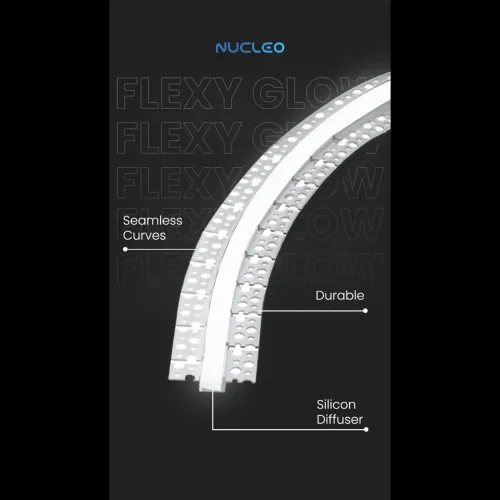
A 25 × 20 mm silicone body with a diffusing lens spreads 36 LED/m into one band of colour on the wall.
Bends sideways, up and down, and twists to follow curved walls, arches, columns and stair edges.
Dust-tight and rated for temporary immersion, so one product covers lobbies, terraces and facades.
Low-voltage supply with predictable loading: 120 W for a 5 m reel.
Blend warm and cool white channels to match stone, timber or paint, from roughly 2700K to 6500K.
Split a long wall into DMX zones and run them as one wash or as independent sweeps.
Scenes from welcome white to evening colour.
Wall colour matched to the event theme.
Programmable colour for festivals and brand days.
Mood walls that shift through service.
Brand colour with a neutral daytime white.
Cyclorama-style backdrops for sets and broadcast.
A continuous wash around soft geometry.
Colour wrapped around round or oval columns.
Movement synced to music or show control.
Warm white daily, colour for festivals.
| Model | NLSW-2520 |
|---|---|
| Body size | 25 × 20 mm silicone |
| Voltage | 24V DC |
| Power | 24 W/m |
| LED density | 36 LED/m |
| LED type | RGBWW, 5 channel |
| Control | DMX512 |
| Protection | IP67 |
| Bending | 3D |
| Reel length | 5 m |
Share wall lengths, finishes and your control system, and our team will help with reels, DMX decoders, power and zoning.
It has five LED channels: red, green, blue, warm white and cool white. The RGB channels make colour, while the two white channels give a clean white and a tunable range, without the tint that RGB-only mixing often leaves.
DMX512 is the standard protocol in hotels, theatres and venues. It lets a controller address each zone for colour, brightness and timing, so sweeps, synced walls and saved scenes are programmed rather than switched by an RF remote.
A 24V DMX decoder or DMX-enabled driver sized for the load, plus a DMX source such as a console, Art-Net bridge or lighting software. The strip uses five channels per address, so confirm the decoder's channel mode before ordering.
The strip draws 24 W/m, so a 5 m reel is 120 W. Use a 24V supply rated at least 150 W per reel. For several reels, total the wattage and keep about 20% spare capacity.
Yes. The silicone body is IP67 rated. Keep the decoder and driver in a dry, ventilated enclosure, and seal cut ends and joints with proper end caps and waterproof connections.
Yes. With only the white channels active it shows white without a colour cast. Blending warm and cool white tunes the light between roughly 2700K and 6500K.
The NLSW-1616 is a smaller fixed-white washer. The NLSW-2520 is a larger 25 × 20 mm RGBWW strip with DMX512 control. Choose the 1616 for a static white wash and the 2520 where colour or scene control is needed.
Start at 100–200 mm for interiors: closer for a tighter gradient, further for a broader wash. Mock up a short run with your actual colours first, since coloured light looks different on every finish.