Five PCB widths
3, 5, 8, 10 and 15 to 20mm options so the strip can match the profile rather than the other way round.
 Chat with us
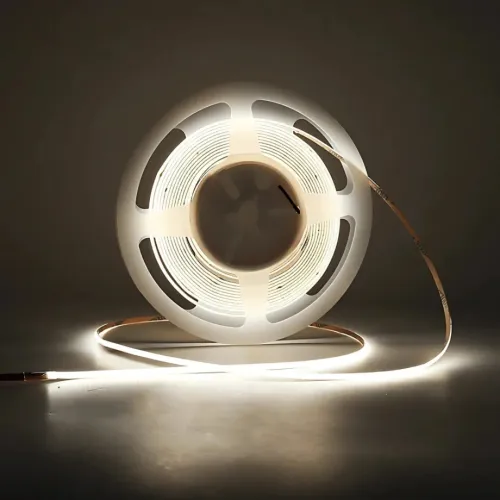
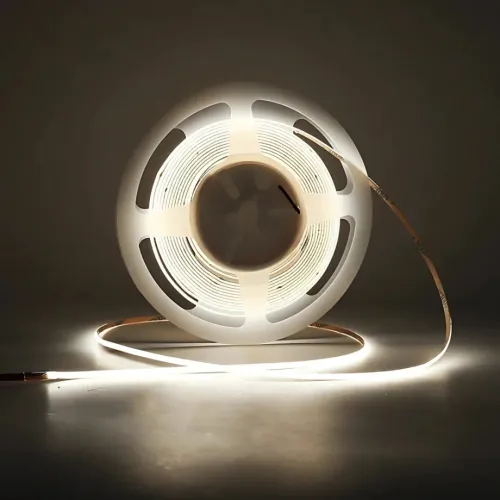
The 2835 24V range gives designers a predictable base for cove lighting, joinery and linear architecture: five PCB widths, densities from 60 to 480 LEDs per metre, and the headroom for long continuous runs.
Most strip problems on site trace back to one early decision: the strip did not suit the channel. PCB width fixes the profile, the profile fixes the diffuser depth, and diffuser depth decides how dense the strip must be.
The SMD 2835 chip is the efficient workhorse of this range, delivering roughly 24 to 26 lumens per LED at CRI 80+. Paired with 24V constant voltage, colour stays consistent and brightness holds across the long runs that hotels, retail perimeters and large homes demand.
This page walks through the choices in the order a specifier makes them, so the strip you draw is the strip that arrives.
Around 60 to 120 LEDs per metre is enough behind a deep diffuser or in an indirect cove viewed from a distance. Tight channels, mirror surrounds and joinery edges usually need 168 to 240 LEDs per metre to avoid visible dots.
3, 5, 8, 10 and 15 to 20mm options so the strip can match the profile rather than the other way round.
Choose sparse for deep indirect coves or dense for tight, close-viewed channels.
Half the current of 12V at the same wattage, so less voltage drop and longer feeds.
Natural-looking materials and finishes, from timber to fabric to stone.
2700K to 6500K single white, plus tunable white and RGBCCT variants.
Engineered to hold even brightness along 20 metres from one connection point.
Trim to the exact run on site and rejoin with connectors or solder.
Designed to sit in Nucleo aluminium channels with adhesive backing for fast fixing.
Measure the internal width of the profile slot, not the outside. A strip that is even a millimetre too wide will lift at the edges and show as a visible kink in the light line.
No brightness drop, no hotspots, no surprises on handover day. Choose the width, density and CCT once, and the result is what the drawing promised.
Long continuous runs where a dropless roll keeps the ceiling wash even.
Ceiling coves and tray ceilings in living rooms, bedrooms and lobbies.
Wardrobes, vanities and bespoke cabinetry with concealed lighting.
Shelf edges, wall fixtures and display niches in showrooms and stores.
Task and display light from dense 240 LED/m configurations.
Open-face multi-line strips for backlit panels and statement surfaces.
Reception, atria and linear architectural elements in offices and brand spaces.
Even, frontal light at close viewing distance.
At the same wattage, 24V draws half the current of 12V. That means less voltage drop, longer runs from a single feed and thinner supply cabling, which is why it is the professional standard for long cove runs.
3mm suits ultra-narrow slots, 5mm fits most recessed and surface profiles, 8mm suits medium surface and corner profiles, 10mm suits standard cove and wide recessed channels, and 15mm and 20mm multi-line strips suit open-face channels. Always check the internal channel width before ordering.
It depends on diffuser depth. Deep diffusers and distant viewing work with 60 to 120 LEDs per metre. Tight channels, mirror surrounds and joinery usually need 168 to 240 LEDs per metre for a smooth line.
Single-white options include 2700K, 3000K, 3500K, 4000K, 5000K and 6500K. Tunable white and RGBCCT variants are also available for dynamic and mood lighting.
Multiply watts per metre by the total run length, then add about 20 percent headroom. Use a 24V constant-voltage driver rated at or above that figure, and split very long runs across more than one feed.
It is a roll engineered to hold consistent brightness across its full 20 metre length from a single 24V connection, avoiding the extra injection points that standard 5 metre rolls need on long runs.
Yes. Cut only at the marked cut points on the PCB, then rejoin with solderless connectors or solder. Keep cut lengths in whole segments so every section lights fully.
Send us your profile type and run lengths. We will confirm width, density, CCT and driver sizing before you order.