01
Dot-free output
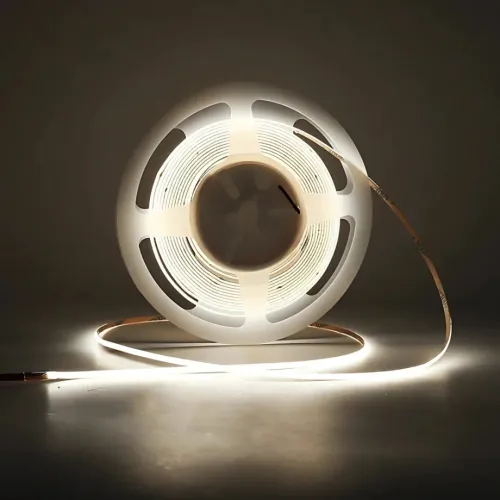
A continuous phosphor layer fuses the chips into one even line, even at very close range.
 Chat with us
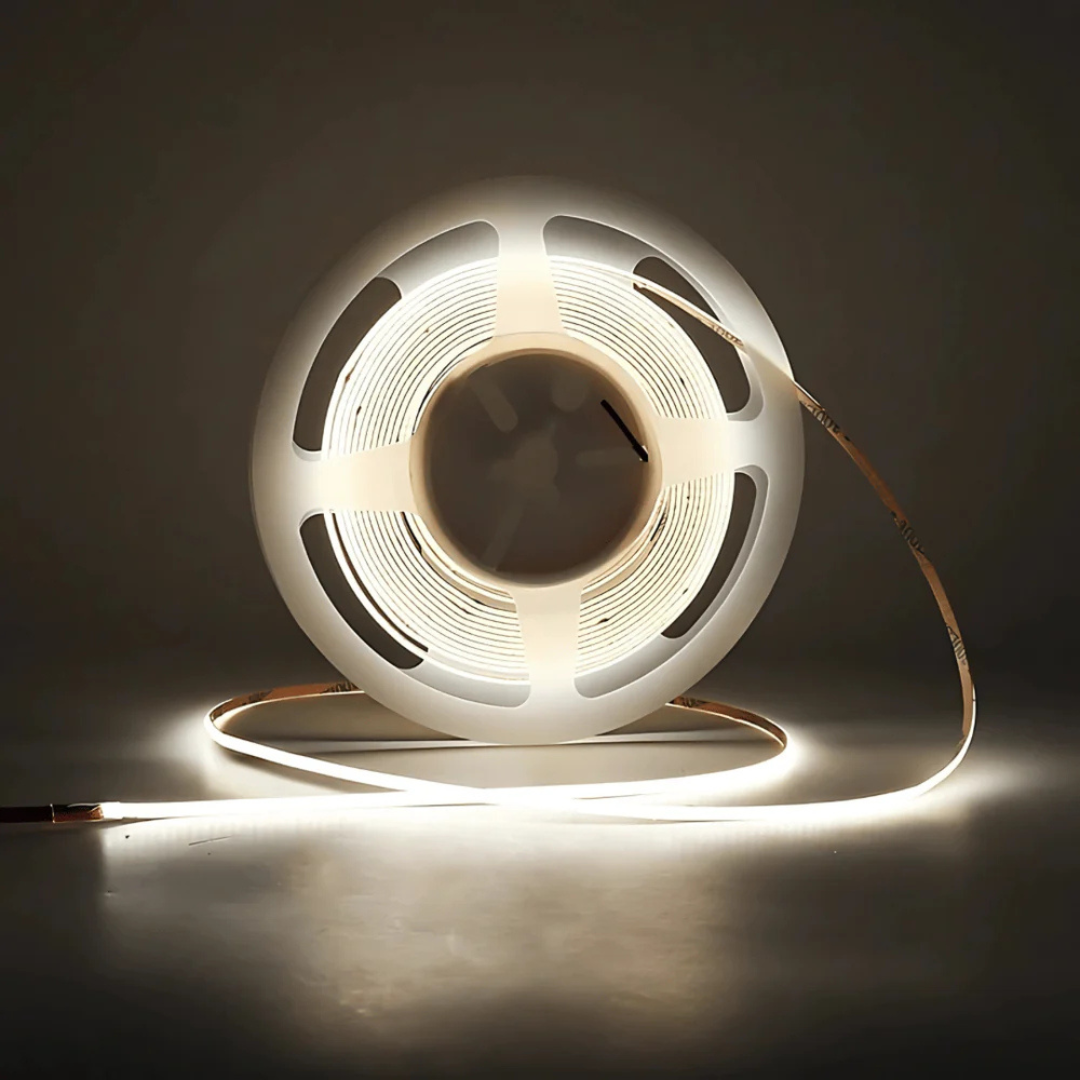
Nucleo COB LED strips replace the familiar row of bright points with a single, continuous glow. Fit one into a shallow cove, a tight joinery recess or an aluminium profile and the light reads as a clean architectural line.
A designer's biggest complaint about LED strip is rarely brightness. It is the visible dots that appear on a wall, a ceiling edge or a glossy surface when the diffuser sits too close. COB (chip-on-board) construction solves this at the source.
Many tiny chips sit under one continuous phosphor layer, so the strip emits a smooth, uniform ribbon of light. That makes it the natural choice wherever the strip is seen close up: shallow coves, under-cabinet recesses, wardrobe edges, stair risers and slim profiles.
Nucleo supplies COB strips for interior designers, architects and electrical contractors across India, with guidance on profile, driver and colour temperature for each project.
Choose COB when the strip will sit within a few centimetres of a reflective or lightly diffused surface. If the viewing distance is long and the diffuser is deep, a standard SMD strip may be enough, and COB then becomes a quality upgrade rather than a necessity.
A continuous phosphor layer fuses the chips into one even line, even at very close range.
Works in recesses where an SMD strip would show hotspots, so coves can be slimmer and joinery cleaner.
Bends around gentle curves and is cut at the marked points on the PCB to fit the exact run.
Sits neatly in Nucleo aluminium channels for heat control, alignment and a finished edge.
Runs from a constant-voltage driver, keeping installation safe in joinery and wet-adjacent areas.
Uniform phosphor coating gives even colour along the length, which helps long continuous sightlines.
Pairs with compatible dimmable drivers for scene control and mood lighting.
Peel-and-stick backing speeds up fixing inside profiles and on clean, dry surfaces.
Clean the surface with isopropyl alcohol before fixing the adhesive, and press the strip along its full length. For long runs, feed power from both ends to keep brightness even from first metre to last.
When the fixture disappears and only the line remains, the architecture does the talking. That is what COB is for.
Slim ceiling coves with a smooth, hotspot-free wash on the ceiling.
Vertical edge strips that light clothing evenly without glare.
Even task light over counters with no dotted reflections on stone or glass.
Concealed lighting under glass or timber shelves for retail and home displays.
Soft frontal light around vanity mirrors and dressing tables.
Continuous guide lines along risers and handrail recesses.
Back-lit panels and niches with a clean halo and no visible chips.
Reception counters, bar fronts, showroom edges and signage outlines.
A COB strip packs many tiny LED chips under a continuous phosphor layer, so the output reads as one unbroken line. SMD strips use individual visible chips that can show as dots when the diffuser is shallow.
Not for the dot-free look, since COB removes the dots by itself. A profile is still recommended for heat dissipation, straight alignment, protection and a clean finished edge.
Yes. Flexible strips are cut only at the marked cut points on the PCB, and reconnected with solderless connectors or soldered joints.
Use a constant-voltage driver that matches the strip's rated voltage, with the total load including roughly 20 percent headroom. Confirm voltage and wattage per metre with Nucleo before ordering.
Feed power from both ends or from several points on long runs, use adequately thick cable between driver and strip, and keep individual runs within the limit recommended for the strip's voltage.
Yes. Because there are no individual dots, COB works well where the strip sits close to the diffuser or is seen from a short distance.
Warm white suits hospitality, bedrooms and living spaces. Neutral white suits kitchens, retail and workspaces. Keep one colour temperature consistent across a continuous sightline.
Share your drawings or run lengths and the Nucleo team will help you choose the right strip, profile and driver.