Not Every Line in a Building Is Straight
The NLP-1512 exists for the moment the design stops being a straight line
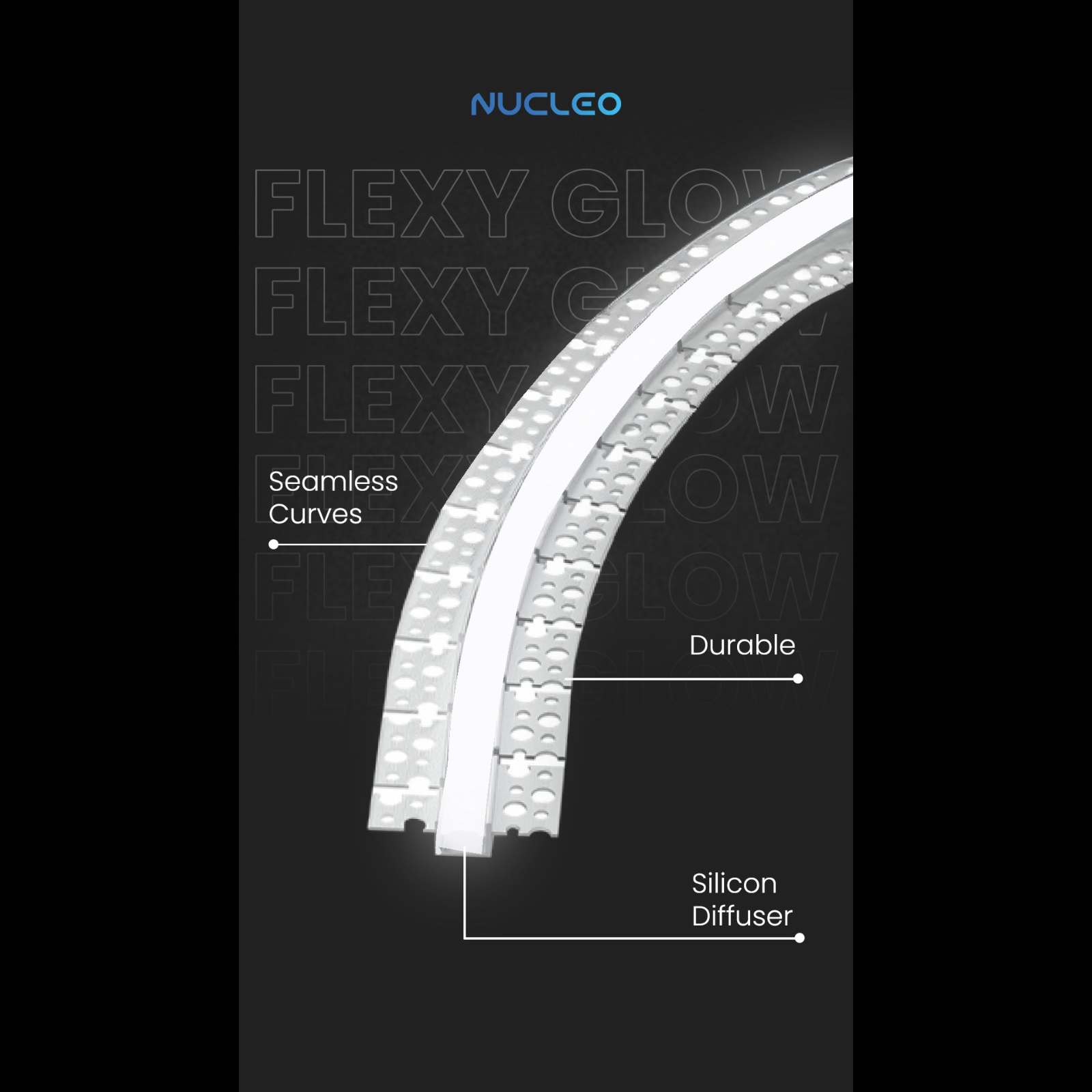
Most LED profiles are engineered for straight runs and get awkward the moment a design calls for something else — a curved staircase stringer, an arched opening, a coved ceiling that sweeps instead of cornering. The NLP-1512 is Nucleo's answer to that moment: a flexible aluminium channel that bends smoothly into an S-curve or a gentle arc without kinking, cracking, or losing its shape once fixed in place.
It isn't a specialist product reserved for unusual jobs, either. The same channel handles straight sections just as cleanly, so a single profile can carry a light line from a flat wall, around a curved corner, and back to flat again — with no visible joint where flexible meets rigid, because there's only ever one profile.
What Makes It Bend Without Breaking
Six things the NLP-1512 does differently from a standard rigid channel
True S-Bend Capability
The extrusion flexes into curves and reverse S-shapes on site — not just a gentle arc, but a genuine change of direction within a single run.
Diffuser Bends With the Body
The silicone diffuser flexes along with the aluminium, so the light-emitting face stays continuous through the curve with no seam or hotspot.
Short-Piece Handling
Supplied in shorter lengths that are easier to flex accurately on site, then abutted end to end so the curve reads as one unbroken line.
Aluminium Heat Sink
The aluminium body still draws heat away from the LED strip PCB even when curved, protecting strip lifespan the way a plastic channel never could.
Push-Fit Diffuser
No adhesive needed — the diffuser presses into the channel groove and stays seated through the bend, on straight sections and curved ones alike.
Surface Mount, No Plasterwork
Fixes directly to the existing wall, stringer, or furniture edge — no ceiling cutout or recessed cavity required before installation begins.
One Profile, Straight and Curved
A curved section usually means sourcing a second, specialist profile — different housing, different diffuser, a visible joint where it meets the straight run either side. The NLP-1512 removes that decision entirely: the same channel does both jobs, so the light line through a staircase, an archway, or a curved reception desk reads as one continuous element from start to finish, not two products stitched together.
Built for the Curve, Not Just the Straight Run
On a staircase, the light line has to follow the stringer through every change of pitch and direction — something a rigid profile simply can't do without multiple mitred joints. The NLP-1512 is flexed by hand around the actual curve on site, so the fixing follows the real geometry of the stair rather than an approximation of it.
Where a Curved Light Line Earns Its Place
Spaces where the architecture curves and the light needs to follow
Staircase Stringers
Follows the pitch and turn of curved stairs in one continuous fixed line.
Coved Ceilings
Traces a sweeping ceiling transition without a break where the curve begins.
Arched Doorways
Bends around the full radius of an arch as a single unbroken outline.
Columns & Pillars
Wraps curved columns cleanly, following the exact circumference on site.
Curved Furniture Edges
Fits joinery and furniture profiles that were never designed with straight lines.
Reception Counters
Follows a curved counter front as one continuous light line, no visible joint.
Retail Display Curves
Outlines rounded display fixtures and shelving without breaking the run.
Hotel Corridor Coves
Carries a continuous cove line through corridor bends and transitions.
Frequently Asked Questions
Installation and specification questions on the NLP-1512
-
The channel bends smoothly down to roughly a 100–150mm radius, which covers the majority of staircase stringers, arched doorways and coved ceiling transitions found in residential and commercial interiors. Very tight spiral forms should be discussed with our team before final specification.
-
Shorter pieces flex more naturally around a curve without the aluminium fighting back or developing a visible kink. On site they're simply abutted end to end along the curve, and any straight sections just continue the same run — there's no separate straight-length product to source.
-
No. The push-fit silicone diffuser flexes together with the aluminium body, so the light-emitting face stays continuous through the curve. Because the diffuser itself bends rather than being pre-shaped, there's no seam or joint in the optic where the profile turns.
-
It works perfectly well on straight runs — many projects use one profile for both the straight sections and the curved transitions between them, so the light line reads as a single continuous element rather than two different products meeting at a joint.
-
The box includes the aluminium channel, the silicone diffuser and end caps — everything needed to install the housing itself. The LED strip is chosen separately from Nucleo's strip range, so the colour temperature, brightness and CRI can be matched to the specific project rather than fixed in advance.
-
No cutout is required — the NLP-1512 is a surface-mount profile that fixes directly onto the existing wall, ceiling, stringer or furniture edge with clips or adhesive. There's no plasterwork, no recess to cut, and no specialist trade needed to complete the installation.
Specify the NLP-1512 for Your Curved Run
Our team can help with bend radius planning, strip pairing, and layout for your NLP-1512 installation.