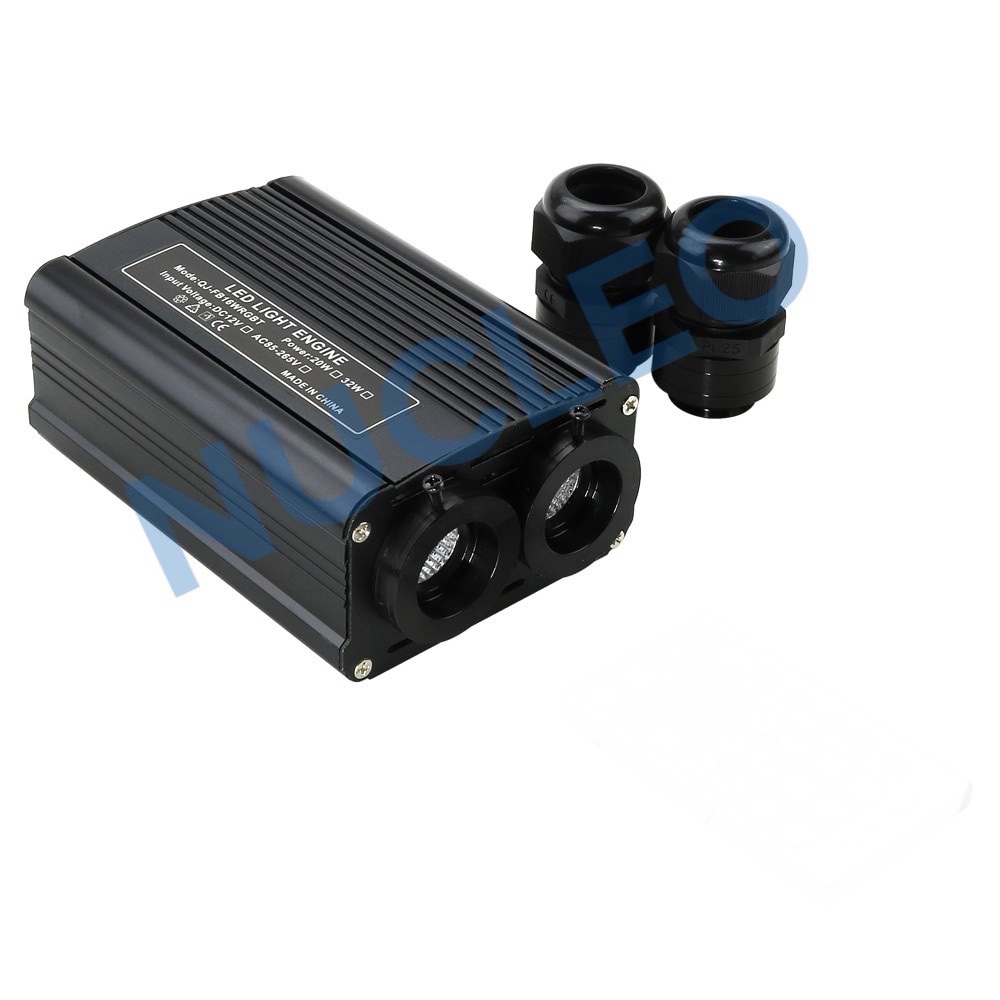
The Engine Stays Hidden.
Only Light Reaches
the Destination.
Fiber optic illuminators separate the electrical source from the light endpoint — enabling safe, maintenance-free illumination in pools, galleries, star ceilings and any space where electrical current at the emission point is not acceptable.
Conventional LED fixtures carry electrical current to each emission point. For most applications that is acceptable. For pools, artworks, wet rooms, children's spaces, and large-format ceiling installations, it creates problems that IP ratings and isolation systems can only partially address.
A fiber optic illuminator — called a light engine — generates high-intensity LED light inside a sealed unit installed in a safe, accessible location: ceiling void, plant room, or equipment cupboard. The fibers carry only light through total internal reflection to wherever it needs to appear. No electrical component exists at the ceiling point, pool wall, or embedded panel. This is not an IP protection measure — it is a fundamental architectural distinction.
The same engine handles colour control for every emission point in its bundle simultaneously. One engine change handles the entire installation without touching a single point on the ceiling or pool floor.
In a 500-point star ceiling using conventional LED, servicing a failed lamp means accessing 500 individual fittings embedded in plaster, acoustic tile, or tensioned fabric. With a fiber optic system, every point in that ceiling is served by one engine. Servicing or replacing the engine — from an accessible void or plant room — restores the entire installation. The fibers themselves have no electrical components and require no maintenance over the life of the installation.
All five models are available in the full range of colour and control variants: Single Colour, CCT, RGBW and DMX.
Specify the variant that matches your project's colour output and control infrastructure. Model and variant are independent selections.
PMMA Fiber Compatible
All models accept PMMA end-emitting fiber in standard diameters — 0.75mm, 1mm, 1.5mm, 2mm and 3mm. Side-emitting PMMA is also supported. Maximum recommended run is approximately 15 metres per PMMA bundle.
Active Thermal Management
Each engine includes a temperature-controlled fan with automatic speed adjustment. Maintaining LED junction temperature within safe limits is what delivers the 50,000-hour rated lifespan — active cooling is essential for this performance level.
DMX512 Pro Integration
DMX variants include 3-pin XLR input and pass-through output for daisy-chaining multiple engines on a single DMX line. Compatible with GrandMA, ETC EOS, Chamsys, and any standard lighting controller or building management system.
Built-In Shooting Star (NLE-5S)
The NLE-5S's internal motorised mechanism randomly varies light output across individual fibers, creating natural twinkling and shooting star effects without any external programming or controller. Begins immediately on power-on.
Independent Dual Zones (NLE-36)
The NLE-36's two 20mm ports operate independently — different zones can run different colours, brightness levels or scenes from a single engine. Ideal where two ceiling areas share a void but need separate control.
Pool-Safe Architecture (NLE-90)
The NLE-90 engine locates entirely outside the pool. Inert PMMA fibers route through the pool structure — zero electrical voltage at any underwater point. This is the fundamental distinction from IP-rated LED pool fittings, where electrical components remain inside a waterproof housing.
No UV or IR at Emission Point
Infrared and UV radiation are filtered at the illuminator before light enters the fiber bundle. The fiber tip emits only visible light — no heat, no UV. This qualifies fiber optic for museum and gallery applications where artwork preservation is a hard specification requirement.
Single-Point Maintenance
Every fiber endpoint in a ceiling, pool, or panel is served by one engine. All servicing happens at the engine in the accessible void or plant room. The fiber endpoints require no maintenance over the installation lifetime — a decisive advantage in large-scale or inaccessible installations.
Light Generation at the Engine
The LED module inside the illuminator generates high-intensity light at the selected colour or CCT. In RGBW and CCT variants, individual LED channels are mixed to produce the desired output. In the DMX variant, an onboard decoder modulates the channels in response to incoming DMX512 signals.
UV and IR Filtration
Before light enters the fiber bundle, UV and infrared radiation are filtered at the output port. Only visible light passes into the fibers — eliminating heat and UV at the endpoint, making fiber optic safe for artwork, textiles and children's spaces.
Fiber Coupling at the Output Port
A precision collimating lens at the 20mm or 30mm output port focuses filtered light into the input face of the fiber bundle. Port diameter determines fiber count — a 30mm port accepts approximately twice the fiber count of a 20mm port at the same fiber diameter.
Light Transmission Through the Fiber Bundle
PMMA fibers carry light via total internal reflection with minimal loss over runs up to 15 metres. Fibers route through ceiling voids, wall cavities, and pool walls without any electrical concern at the routing points — they are inert optical waveguides.
Emission at the Endpoint — No Electricity Present
At the termination point — in a star ceiling, pool wall, or decorative panel — the fiber tip emits light with no heat, no UV and zero electrical voltage. The endpoint can be embedded in soft furnishings, submerged in water, or placed against temperature-sensitive materials without any risk.
| Parameter | NLE-18 | NLE-36 Dual | NLE-45 | NLE-5S | NLE-90 Pool |
|---|---|---|---|---|---|
| Output Port | 20mm × 1 | 20mm × 2 | 30mm × 1 | — | 30mm × 1 |
| Max Points (0.75mm) | ~600 | ~600 per port | ~1200 | — | ~1200 |
| Key Feature | — | Dual zone | High capacity | Shooting star | Pool application |
| Colour Variants | Single Colour · CCT · RGBW · DMX — all available on every model | ||||
| Control (Single CCT) | Manual — no controller needed | ||||
| Control (CCT / RGBW) | RF remote · Wi-Fi / Bluetooth app · DMX512 | ||||
| Control (DMX variant) | DMX512 via 3-pin XLR · pass-through output for daisy-chaining | ||||
| Fiber Compatibility | PMMA end-emitting 0.75mm, 1mm, 1.5mm, 2mm, 3mm · Side-emitting PMMA | ||||
| Max Fiber Run | ~15m PMMA (contact us for glass fiber on longer runs) | ||||
| Input Voltage | AC 100–240V, 50/60Hz | ||||
| Cooling | Active fan, temperature-controlled auto-speed | ||||
| LED Lifespan | 50,000 hours at L70 | ||||
| Warranty | 2 Years (Nucleo Standard) | ||||
Fiber optic is the technically correct choice wherever electrical current at the emission point is a safety, conservation, or maintenance concern.
Residential Star Ceilings
Bedrooms, home cinemas, media rooms. NLE-18 for standard rooms, NLE-5S for natural twinkling and shooting star, NLE-45 RGBW for dynamic colour scene installations.
Swimming Pools & Spas
NLE-90 engine in the dry plant room — only inert fibers enter the pool. Zero electrical hazard at underwater emission points. Suitable for residential and hotel pool installations.
Hotel & Hospitality
Lobby constellation ceilings, restaurant feature vaults, spa treatment rooms. NLE-45 for large-area installs, NLE-36 dual port for zoned lighting from a single engine.
Museums & Art Galleries
No UV or IR at the emission point — the only technology safe for illuminating pigments, textiles and temperature-sensitive materials at close range without any risk of damage or degradation.
Children's Spaces & NICU
Nurseries, paediatric wards, sensory rooms. Fiber endpoints can be embedded in soft furnishings, ceiling panels, and wall linings with zero heat and no electrical hazard at any point.
Themed & Entertainment
DMX variant for full show-control integration. Multiple NLE-36 dual port engines support complex zone programming across large-format themed installations and attractions.
Spa & Wellness Centres
Wet steam rooms, hydrotherapy pools, and treatment suites. Fiber optic eliminates the electrical safety concern in high-humidity and water-contact environments by design.
Luxury Restaurants & Bars
RGBW or CCT variant allows colour temperature shifts across a dining service without accessing the ceiling. Scene control via app or DMX at the engine location only.
Specify Nucleo Fiber Optic Illuminators for Your Next Project
Model selection guidance, fiber count calculations, project pricing and technical drawings. Star ceilings, pool installations, gallery projects and hospitality — contact us with your brief.
Pan-India delivery · Mumbai · Delhi · Bangalore · Hyderabad · Chennai · Pune · Ahmedabad · Kolkata · Jaipur · Surat · Lucknow · Chandigarh · Kochi · Nagpur · Indore · Coimbatore · Bhopal