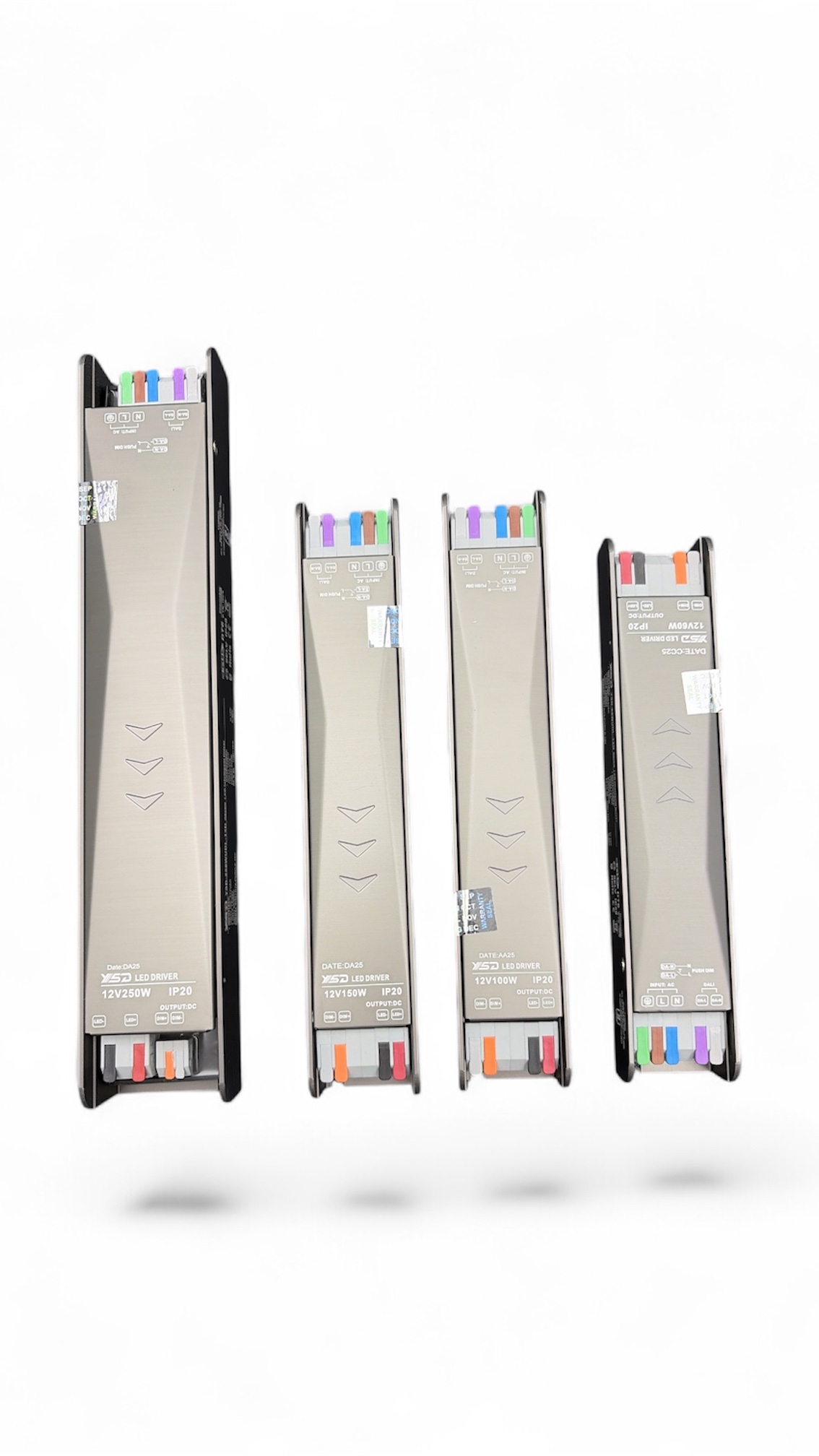
Most LED power supply failures in the field come down to a protocol mismatch — the dimmer in the wall, the BMS output on the panel, and the driver on the ceiling are not speaking the same language. The CP Series eliminates that problem by accepting five dimming protocols on the same unit: Triac, 0-10V, 1-10V, 10V PWM and Resistor. Specify one driver for the whole project, regardless of what control system is installed.
At 29mm slim, it disappears into places where standard drivers cannot go — inside LED aluminium profiles, shallow false ceiling voids, furniture recesses and narrow installation boxes. Available in 12V, 24V and 48V DC from 60W to 200W, with flicker-free output from 1% to 100% at every dim level.
✦ Five Dimming Protocols. One Driver.
The CP Series is the only driver you need to specify for a mixed-control project. Triac for standard wall switches. 0-10V / 1-10V for BMS and analogue controllers. 10V PWM for microcontroller-based systems. Resistor for the simplest potentiometer control. The same unit accepts all five — no variant SKUs, no rewiring, no surprises on site.
🔁
Triac
Phase-cut dimming (leading / trailing edge). Works directly with standard wall dimmer switches — no extra wiring or controller needed.
📉
0–10V
Industry-standard analogue signal. Compatible with BMS panels, KNX, Crestron and 0-10V analogue outputs. Widely used in commercial projects.
📊
1–10V
Analogue dim signal with 1V minimum floor. Common in commercial lighting control panels, legacy ballast controllers and European BMS systems.
〰️
10V PWM
Pulse-width modulation at 10V signal level. For microcontroller, Arduino, Raspberry Pi or any PWM-output lighting control system.
🎛️
Resistor Dim
Simple potentiometer or fixed resistor for manual dimming. Lowest-cost control option with no external controller required — ideal for fixed ambient settings.
Which voltage to choose? Use 12V for strip runs up to ~5m per channel. Use 24V for runs up to ~10m with better voltage drop management. Use 48V for long continuous runs of 20m or more using 48V-rated LED strips — dramatically reducing the brightness drop-off that affects long 12V or 24V runs at the far end.
📐
29mm Ultra-Slim
Fits inside LED aluminium profiles, false ceiling voids, furniture recesses and shallow mounting boxes where standard drivers cannot be concealed.
🎚️
5-in-1 Dimming
Triac, 0-10V, 1-10V, 10V PWM and Resistor dim on one unit — compatible with virtually every dimmer and controller on the market without changing the driver.
✨
Flicker-Free Output
High-frequency exemption level PWM. Soft, smooth, jitter-free dimming from 1% to 100%. No flicker at any dim level — safe for WELL and HCL applications.
🌬️
Fanless Convection Cooling
No moving parts, no noise, no maintenance intervals. Silent operation — appropriate for residential, hospitality and acoustic-sensitive spaces.
🛡️
Auto-Recovery Protections
Overload, over-temperature, short circuit and over-voltage protection — all with automatic recovery. No manual reset required after a protection event clears.
🏠
Class I / II / III
Suitable for internal Class I, II and III lighting — covering the full range of residential, commercial and architectural installations without additional compliance steps.
What dimming protocols does the CP Series support?
Five protocols on a single unit: Triac (phase-cut, compatible with leading and trailing edge wall dimmers), 0-10V analogue, 1-10V analogue, 10V PWM signal, and Resistor dimming. One driver model works with virtually any dimmer switch, BMS analogue output, microcontroller or simple potentiometer without specifying a different driver for each control type.
What is the minimum dim level and does it flicker at low settings?
The CP Series dims smoothly from 100% to 0%, with LED start possible from as low as 1%. High-frequency PWM at exemption level eliminates visible and physiological flicker at every dim level — no shimmer, no jitter, no drop-out at low settings. This makes it suitable for occupied spaces under WELL and Human Centric Lighting (HCL) requirements.
Which voltage should I choose — 12V, 24V or 48V?
Use 12V for LED strip runs up to approximately 5m per channel. Use 24V for runs up to 10m to reduce voltage drop. Use 48V for very long strip runs of 20m or more using 48V-rated LED strips — significantly reducing brightness unevenness at the far end of an extended run without requiring mid-run injections.
Why does the 29mm profile matter for installation?
Most standard LED power supplies are 40mm or taller and cannot be concealed inside LED aluminium profile channels, shallow false ceiling voids, furniture cavities or thin mounting boxes. The 29mm CP Series fits inside spaces where standard drivers do not — letting the driver be hidden within the lighting element itself for a cleaner installation with no visible driver box.
Is the CP Series suitable for LED strips and profile lighting?
Yes. The CP Series is a constant voltage driver — 12V and 24V versions for LED strips, aluminium profiles and neon flex; the 48V version for long-run 48V-rated strip systems. Do not use a constant voltage driver to power individual COB modules or constant current spotlight fixtures directly — those require a constant current driver.
What happens when the driver trips a protection fault?
All protections — overload, over-temperature, short circuit, and over-voltage — include automatic recovery. When the fault condition clears, the driver resumes normal operation without any manual reset or fuse replacement. This is particularly important for ceiling-concealed installations where physical access to reset a driver is impractical.
Can I use the CP Series with a standard Triac wall dimmer?
Yes. Triac phase-cut dimming is one of five supported protocols. The driver accepts both leading-edge and trailing-edge Triac signals from standard wall dimmer switches — making it a compatible replacement in existing installations with Triac infrastructure without rewiring the control circuit.