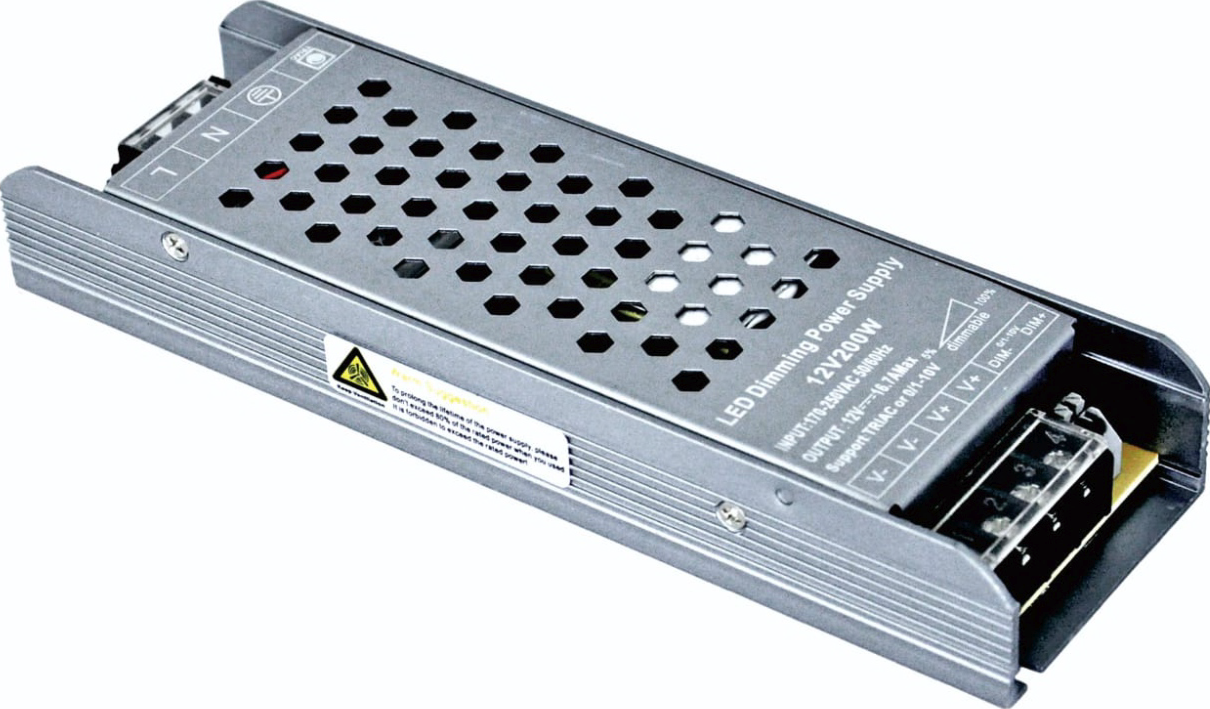
Factory-Tested Reliability for Demanding Installations

A LED power supply failure on a completed project is costly — remedial access, downtime, replacement parts. The CD Series addresses this at source. Before any unit leaves the factory, it is run at 100% of its rated output wattage for a full-load burn-in period. This stress-tests every component under real operating conditions and screens out the early-life failures that cause drivers to fail within their first hours of use.

The result is a driver with a substantially lower field failure rate than comparable untested units. For commercial architects, lighting designers and electrical contractors, this matters: the CD Series is a driver you can install with confidence in a finished ceiling or inaccessible cove and expect it to keep running.

🔬 What a Burn-In Test Actually Does

Electronic component failures follow a bathtub curve — failure rates are highest at the very beginning of life (infant mortality) and again at end of life. A full-load burn-in test accelerates the infant mortality phase at the factory before the driver ships. Units that would fail in the first 50 hours of field use instead fail during the burn-in cycle and are removed. What reaches your installation has already survived its most vulnerable phase.

500W
Max Output
Single driver, no paralleling needed
4
Gear Steps
25 / 50 / 75 / 100% DIP selectable
8
Wattages
60W to 500W continuous range
IP20
Rated
Indoor concealed install

4-Gear DIP Switch Dimming — No External Controller

The CD Series includes a DIP switch bank on the driver body. Select one of four brightness levels before installation — the driver locks to that output and maintains it stably regardless of mains voltage fluctuation. No dimmer switch, 0-10V controller, Triac phase signal or DALI bus is required.

25%
Low Ambient
50%
Half Output
75%
Task Level
100%
Full Output

When to Use Gear Dimming vs. Continuous Dimming

Gear dimming is the right choice when a consistent, architect-specified brightness level is required and the brightness does not need to change dynamically by occupants or a BMS. Common applications: display lighting set to 75%, commercial cove preset to 50% for ambient, full-brightness task lighting at 100%.

If you need variable brightness controlled from a wall plate or building management system, the CP Series (Triac / 0-10V / PWM dimming) is the appropriate choice. The CD Series simplifies the installation by removing the dimmer circuit entirely — fewer components, fewer points of failure.

🌅

Slow Start — Selectable Soft On at Power-Up

When slow start is selected via the DIP switch, the output ramps up gradually from zero to the set brightness level at power-on, instead of switching instantly to full output. This prevents the abrupt glare flash that disrupts occupant comfort — critical in hotel rooms, bedrooms, galleries, restaurants and retail environments where the experience of turning the lights on matters as much as the end result. Instant-on mode is also selectable for task, emergency or switching applications where immediate full output is required.

Available Models

Eight wattages across both 12V and 24V DC. All models are IP20, fanless, and burn-in tested.

12V DC Output
WattageMax CurrentDimensions (L × W × H)
60W5.0 A170 × 35 × 23 mm
100W8.3 A145 × 48 × 24 mm
150W12.5 A195 × 48 × 24 mm
200W16.7 A215 × 48 × 24 mm
250W20.8 A236 × 49 × 29 mm
300W25.0 A236 × 49 × 29 mm
400W33.4 A236 × 49 × 29 mm
500W41.7 A213 × 62 × 31 mm
24V DC Output
WattageMax CurrentDimensions (L × W × H)
60W2.5 A170 × 35 × 23 mm
100W4.2 A145 × 48 × 24 mm
150W6.3 A195 × 48 × 24 mm
200W8.3 A215 × 48 × 24 mm
250W10.4 A236 × 49 × 29 mm
300W12.5 A236 × 49 × 29 mm
400W16.7 A236 × 49 × 29 mm
500W20.8 A213 × 62 × 31 mm

⚖️ Sizing Guide — Always Apply the 20% Headroom Rule

Total your LED load wattage, then divide by 0.8 to find the minimum driver rating. Example: a 25-metre cove with 16W/m 24V strip = 400W load ÷ 0.8 = 500W minimum — choose the 500W model.

Running a driver continuously above 80% of rated load increases internal temperature, reduces efficiency, and shortens operating life. The headroom keeps the driver cool and extends its service years significantly.

Key Features

🔬
100% Burn-In Tested
Every unit run at full rated wattage before shipping — infant mortality failures caught at the factory, not at your installation.
🎚️
4-Gear DIP Dimming
25 / 50 / 75 / 100% brightness preset via on-board DIP switch. No external dimmer or signal wire needed.
🌅
Slow Start Option
Selectable gradual ramp-up at power-on. Prevents glare flash — ideal for hospitality, retail, and occupied residential spaces.
🌬️
Completely Fanless
Free-air convection cooling across the full 60W–500W range. Silent operation — zero fan noise in finished spaces.
Up to 500W Single Unit
The highest single-unit output in the Nucleo driver range. Powers large commercial cove and strip runs from one driver.
🛡️
Auto-Recovery Protections
Short circuit, overload, over-voltage and over-temperature protection — all with automatic recovery once the fault clears.
🏷️
IP20 Indoor Rated
Designed for dry indoor concealed installation — false ceilings, conduit enclosures, and hidden electrical voids.
🌍
Class I / II / III Compatible
Suitable for internal luminaires across all three safety classes — from standard earthed Class I to SELV Class III fixtures.

Applications

🏗️
Large Cove Systems
🏢
Commercial Offices
🏨
Hotel Corridors
🛍️
Retail & Showrooms
🔲
LED Profile Systems
🍽️
Restaurant Ambiance
🎭
Auditoriums
🏠
Luxury Residences
🖼️
Galleries & Museums
🌃
Architectural Facades
🏥
Healthcare Interiors
📺
Display & Signage

Technical Specifications

ParameterSpecification
SeriesCD Series
Driver typeConstant Voltage (CV)
Output voltage12V DC or 24V DC
Output wattage options60W · 100W · 150W · 200W · 250W · 300W · 400W · 500W
Dimming method4-Gear DIP switch — 25% / 50% / 75% / 100%
Slow startSelectable by DIP switch (slow start / instant-on)
IP ratingIP20
CoolingFanless, free-air convection
Quality assurance100% full-load burn-in test on every unit
Safety complianceWorldwide safety regulations for LED lighting
Application classClass I / Class II / Class III internal luminaires
ProtectionsShort circuit · Overload · Over-voltage · Over-temperature (all auto-recovery)
Installation environmentIndoor dry locations only
Supply territoryPan India

Frequently Asked Questions

What does 100% full load burn-in test mean for a LED power supply?
Every CD Series unit is run at 100% of its rated output wattage at the factory before being shipped. This screens out early-life component failures — known as infant mortality — that would otherwise cause the driver to fail within its first hours of use on site. A driver that passes a full-load burn-in test has already survived maximum electrical and thermal stress, giving significantly higher confidence in long-term reliability compared to drivers that are not individually tested.
How does 4-gear DIP dimming work in practice?
A DIP switch bank on the driver body lets you select 25%, 50%, 75% or 100% output brightness before installation. Set it once, and the driver locks to that level — no external dimmer switch, 0-10V signal, Triac phase signal or DALI controller is needed. The brightness level is stable and won't drift with mains voltage variations. To change it, adjust the DIP switch physically at the driver. This is ideal for commercial and architectural installations where a consistent, specified brightness is required without adding a dimming control system.
Can the CD Series drive LED neon flex as well as LED strips?
Yes. The CD Series is a constant voltage driver — the correct type for both LED strips and LED neon flex (silicone neon flex, flexible LED profiles). Both run at a rated DC voltage (12V or 24V) and the CD Series provides that regulated output. Simply ensure the total wattage of the neon flex or strip run does not exceed the driver's rated wattage. For large neon flex or strip installations, the 250W to 500W models allow a single driver to power a long continuous run.
What is slow start and when should I select it?
Slow start causes the LED output to ramp up gradually from zero to the set brightness when power is applied, rather than switching instantly to full output. Enable it in hotels, residential bedrooms, galleries, restaurants and retail environments where a gentle power-on experience matters. Instant-on mode is better for task lighting, emergency lighting, or any application where immediate full-brightness response is expected by the user.
How do I wire two CD Series drivers in parallel for very large LED runs?
For LED loads exceeding 500W, use two drivers of equal voltage in parallel on the DC output side. Connect both driver positive terminals to one side of the strip run and both negative terminals to the other side. Both drivers must be the same voltage (both 12V or both 24V) and both DIP switches set identically. For best current sharing, feed the first half of the strip from Driver 1 and the second half from Driver 2, rather than both from a single junction point — this balances the load and minimises voltage drop across the full run.
What is the difference between Class I, Class II and Class III luminaire compatibility?
Class I luminaires require an earth connection — accessible metalwork is earthed for safety. Class II luminaires use double or reinforced insulation and need no earth connection. Class III luminaires operate from SELV (Safety Extra Low Voltage, 12–24V DC) and are inherently safe without an earth. The CD Series is compatible with all three classes for indoor luminaire applications — the class of your fixture determines the wiring method, not the driver selection.
What is the maximum single-driver run length for 24V LED strip with the 500W model?
With a 24V strip at 20W/m and standard 2-core 1.0mm² cable, the 500W model (20.8A output) can power up to approximately 25 metres from a single feed point before voltage drop becomes noticeable at the far end. For runs beyond 20 metres, inject power from both ends of the strip — one driver output at each end — to keep the effective cable run to any strip section under 12–13 metres. Always use 24V over 12V for long runs, as voltage drop is proportionally lower at higher voltage.